Run La Trobe
Road/Path

1 Oct 2026 • 12 minutes read


This article is brought to you in partnership with Solushin.
Shin splints have a habit of turning up at the worst possible time. You know the feeling, a dull ache along the inside of your shinbone that starts as a niggle, eases once you warm up, then greets you the next morning a little louder than before. Ignore it long enough and it stops easing at all.
Shin splints are one of the most common injuries in running.
The clinical name is medial tibial stress syndrome, or MTSS, and it affects runners at every level. MTSS is pain along the inner border of the tibia, usually across the lower two thirds of the shin. In plain terms, your shinbone is being asked to handle more load than it can adapt to in the time you’re giving it. Bone gets stronger in response to running, but it remodels slowly. When training load climbs faster than the bone and the muscles around it can keep up, the inner shin becomes irritated and sore.
For new runners, shin splints often show up a few weeks into their running routine, or soon after joining a run club. Enthusiasm is high and the jump from zero to three or four runs a week is a big ask of the lower leg.
Seasoned runners get them too. A marathon block, a sudden shift to faster track sessions, new shoes or a move from trail to hard road surfaces can all tip the balance. Plenty of runners with years of experience first meet shin splints in the middle of their biggest training build.
Ask a group of runners about shin splints and you’ll find plenty who’ve had them more than once. Having had shin splints before is one of the biggest risk factors for getting them again.
Part of the reason is that the most common fix is rest. Time off lets the pain settle, but the mechanics that overloaded the shin in the first place are still there when you lace up again. Build back to the same training load with the same tight calves and stiff ankles, and your shin ends up under the same stress it couldn’t handle last time.
Recovery from MTSS is measured in weeks to months. Typical treatments take around 110 days before a runner is back to pain-free running, which is longer than most marathon training blocks.
Then there are the bills. Physio appointments, a visit to a sports doctor, imaging to rule out a stress fracture, new shoes and orthotics add up quickly. For many runners the hardest cost is the one you can’t claim on private health. A competition season written off, or the marathon you trained months for watched from the sidelines while your entry goes to waste.
Most runners with shin splints will be given some combination of the following:
A gradual return to running is recommended in most recovery plans, and for good reason. Strength work and footwear changes can play a part depending on the runner. Compression sleeves are the most popular recovery choice of the lot, and that’s where the evidence gets interesting.
Compression sleeves feel good, and plenty of runners swear by them for general calf soreness. The trouble is that shin splints are a load problem. A sleeve applies an even squeeze around the whole lower leg and leaves the forces acting on your shinbone as they were.
The research backs this up. In a randomised trial of 74 athletes with MTSS, researchers in the Netherlands compared a graded running program on its own against the same program with added calf exercises, and against the program with a sports compression stocking worn whenever the athletes were walking or running. Time to complete the running program was about the same across every group, and so was satisfaction with the treatment (Moen et al., 2012). Wearing compression added nothing measurable to recovery.
To see why a more targeted approach makes sense, it helps to look at what sits behind the shin.
Your soleus is the deep, flat calf muscle that does a huge amount of work when you run, absorbing force each time your foot lands and driving you forward as you push off. Part of the soleus, along with the tough fascia wrapped around it, anchors to the inner border of the tibia. That’s the same strip of bone where shin splint pain shows up.
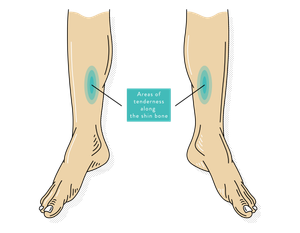
When the soleus is tight and overworked, it tugs on that attachment with every stride. A tight soleus also limits how far your shin can travel forward over your foot, a movement called ankle dorsiflexion. With less ankle range to work with, your lower leg has less room to absorb landing smoothly, so more of that stress lands on the tibia.
This is why physios so often test ankle range with a knee to wall measurement and spend so much time on the calves.
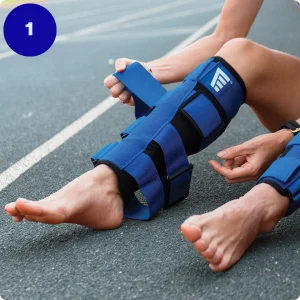
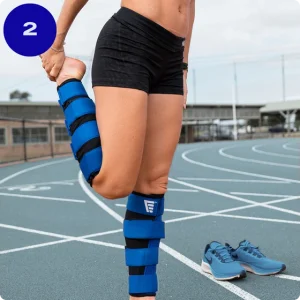
Solushin is an Australian designed treatment device built around this idea. Worn on the lower leg, it uses patented Counter-Traction Technology to apply focal pressure where the soleus attaches, easing how hard the calf pulls on the inner shin. A compressive rod sits over the painful area, and the straps add a slight twisting force that further offloads the site of pain.
Solushin’s own testing found that an hour of wear increased ankle range of motion by 21% on the knee to wall test, a sign the calf tension had eased.
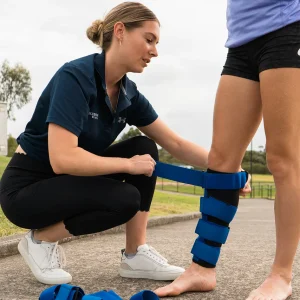
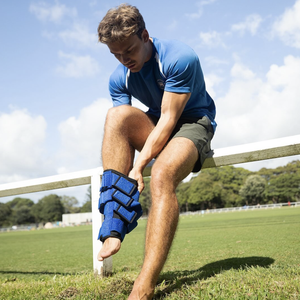
The device has also been tested in a double-blinded, placebo-controlled pilot trial run across two Sydney sports medicine practices and published in BMJ Innovations, a journal from the British Medical Journal group (McNamara et al., 2023). The placebo was a compression sleeve. Runners using Solushin returned to pain-free running in an average of 35 days, compared with around 110 days for typical treatment.
Solushin is worn before or after a run for anywhere from 30 minutes to two hours. You can sit on the couch or take the dog for a walk while it works, and you take it off before you run. In the trial, participants wore it about three times a week for around 100 minutes at a time.
It’s designed to sit alongside a sensible return to running plan, so you keep working on load and strength.
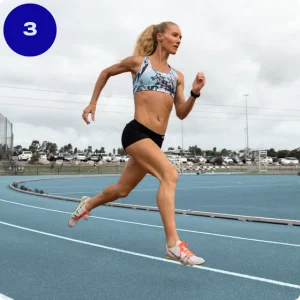
Shin splints are common and stubborn. Rest will settle the pain, and a graded return to running remains the foundation of recovery. If the tight calf and stiff ankle that overloaded your shin are still there when you ramp back up, though, the injury tends to return with them.
Compression sleeves have their place in general recovery, but the research shows they add little when it comes to MTSS. Working on the soleus and ankle range tackles the mechanics behind the pain, and Solushin gives runners a clinically tested way to do that at home.
This article was created in partnership with Solushin. It contains general information only and is not a substitute for individual medical advice. If you have shin pain, speak with a qualified health professional to rule out a stress fracture or other causes.
Find out more and order at solushin.com. Solushin offers 30-day returns if it isn’t the right fit for you.
Moen MH, Holtslag L, Bakker E, et al. The treatment of medial tibial stress syndrome in athletes; a randomized clinical trial. Sports Medicine, Arthroscopy, Rehabilitation, Therapy & Technology. 2012;4:12. https://pmc.ncbi.nlm.nih.gov/articles/PMC3352296/
McNamara WJ, Longworth T, Sunwoo JY, et al. Treatment of medial tibial stress syndrome using an investigational lower leg brace. A pilot for a randomised controlled trial. BMJ Innovations. 2023;9(4):257–263. https://doi.org/10.1136/bmjinnov-2022-001054


Every event, every review, every club you love. Start your free RunDais account and keep it all in one spot.