Inverloch Running Festival
Road/Path


Sat 13 Mar 2027

1 Oct 2026 • 21 minutes read

Lewis Horenko. Former athlete, Athletics Australia coach, founder of 1609.
Somewhere between now and the start line, you are going to feel worse than you have all year. If it’s already happening, keep reading.
Heavy legs. A calf that has suddenly developed opinions. A run that felt like nothing in August and feels like a job today.
You haven’t lost it. I promise you haven’t lost it. You have never in your life paid this much attention to your left calf, and that’s the only thing that’s changed. This is what the taper feels like from the inside. Nobody warns you.
And if the build didn’t go to plan, injury, illness, life getting in the way, breathe. The taper still applies. You just have less to taper from. Cramming now won’t get the missed weeks back. It will only make you tired for the one week that matters.
Here’s the part that’s harder to hear. Most people get this bit wrong. In a study of more than 158,000 marathon builds pulled from Strava, two in three recreational runners didn’t taper properly [4]. Not the training. The taper. Months of good work, then a fortnight of second-guessing, and minutes left out on the road. So let’s not do that.
Training does two things to you at once. It makes you fitter and it makes you tired. The bit nobody tells you is that those two don’t leave at the same speed. Tiredness is a visitor. Fitness lives there. Back off at the right moment and the tiredness packs up, the fitness is still where you left it, and for the first time in months you get to run on all of it.
That’s the whole trick. Scientists have been describing it that way since the 1970s [1], and it’s why pretty much every serious endurance athlete backs off before they race.
The awkward part is the middle. There’s a stretch where the tiredness hasn’t fully left and the freshness hasn’t arrived, and it feels exactly like going backwards. Flat runs. Niggles that turn up from nowhere and leave the same way. That is not the plan failing. That is the plan.
I’d rather show you than ask you to trust me.
Twenty-seven studies on competitive athletes, pooled. The sweet spot was about two weeks of easing off, total volume down 41 to 60 per cent, with the speed of the sessions and the number of training days left untouched [2]. Done properly it’s worth 2 to 3 per cent [3]. Over 42.2 km that isn’t seconds. It’s minutes.
That’s not just the pros. In the Strava study, the runners who held a proper three-week taper, volume falling every single week into the race, came home about five and a half minutes ahead of where the data says they’d have landed off a minimal taper [4]. The ones whose mileage crept back up for a week in the middle gave some of that back. The study calls it a relaxed taper. I’d call it nerves. It’s a very human thing to do.
And you don’t lose anything doing this. You gain something. In a small study of American college runners, three weeks of taper left the aerobic engine exactly where it was. The fast-twitch fibres are what changed. Bigger. Nine per cent more powerful. Three per cent faster over 8 km [5]. A small study of recreational marathoners tapering into their race found a similar pattern, their fast-twitch fibres stronger coming out of the taper than going in [6]. That bounce you feel on race morning, when you’ve done this right, is real. You can measure it in the muscle.
Two honest caveats, because you deserve them. The muscle studies are small. The Strava study is training logs, not a controlled trial, and the authors say so themselves. What settles me is that lab work, real-world data and biopsies all point the same way. When three different kinds of evidence agree, I stop arguing.
Two weeks or three? The lab says two. The real world says three, and four added nothing. Anywhere in between is fine. If this build was the biggest you’ve ever done, lean longer. You’ve got more tiredness to shed.
This is the part the plan never mentions.
In 2023 a group of sport psychologists read everything ever published on the psychology of tapering. Forty-eight studies. The pattern will sound familiar. Mood generally lifts as the taper goes on. Tension often doesn’t. It can sit high all the way to the start line, which the authors put down to plain old performance anxiety [10]. Their conclusion was that the taper is, oddly, both a stressor and a preparation at the same time. So if you feel fresher and edgier in the same week, that isn’t a contradiction. That’s the taper.
What you do with the edge matters more than how much of it you have. Before a big meet, researchers asked 97 elite swimmers and 114 club swimmers about their nerves. The same amount, across both groups. The difference was that the elite swimmers had learned to read their nerves as helping, and they walked onto the blocks more confident because of it [11]. Same feeling. Different story about it. The follow-up paper by the same group has the best title in the whole field: Making the butterflies fly in formation [12].
Men are disturbed not by things, but by the views which they take of things.
Here’s the shape I use with my own athletes. A starting point, not gospel. A hundred-kilometre week and a forty-kilometre week won’t taper identically, but the shape is the same.
| Volume | Long run | Sessions | |
| 3 weeks out | About 80 per cent of your biggest week | 26 to 30 km, or your longest run of the build, whichever is shorter | Keep your normal session. Last proper hit-out at marathon pace. |
| 2 weeks out | About 60 per cent | 16 to 20 km | One shorter session. Something like 3 x 3 km at marathon pace with a jog between. |
| Race week | Roughly half, or less | None. 15 to 20 min easy the day before, with a few relaxed strides. | Midweek: 15 min easy, 4 x 2 min at marathon pace, cool down. Nothing hard after Wednesday. |
This is the one people get wrong. They trade their sessions for slow plodding and wonder why they feel flat on the morning. The kilometres come down. The speed of the fast bits does not.
If you run five days a week, run five. Make them shorter. Your usual rest day stays your rest day; you don’t get three more. Cutting the days didn’t help anyone in the research2, and in my experience it just makes people twitchy. The routine is half the point.
By the time you read this you’re already inside the taper, so let’s start with the week that’s left.
Race week, 5 to 10 October. Roughly half your normal week, or less. The minutes below suit someone who has been running 50 to 60 km a week. Bigger weeks than that, add ten minutes to the easy days. Smaller, take ten off.
Monday. Thirty minutes easy.
Tuesday. Twenty to thirty minutes easy.
Wednesday. Fifteen minutes easy, 4 x 2 minutes at marathon pace, easy cool down. That’s the last thing that feels like work before Sunday. Do it early. The gun goes at 6:15, and your body should have run at that hour at least once this week so race morning isn’t the first time it’s asked.
Thursday. Twenty to thirty minutes easy.
Friday. Twenty minutes easy, or your rest day if that’s where it normally falls. From here the food goes up as the running comes down. The sports nutrition consensus is 10 to 12 grams of carbohydrate per kilo of body weight per day for the last 36 to 48 hours [8]. That’s a lot of rice. It’s meant to be. Spread it across the day and go easier on fibre than usual.
Saturday. Fifteen to twenty minutes easy with a few relaxed strides. If you always rest the day before a race and it settles you, rest. That’s the only extra day off I’d give you.
Sunday. 42.2 km, flatter than it has ever been, finish on the G. Go out like someone who knows that.
And the fortnight before it. If you’ve still got two weeks, this week is the middle row: long run down to 16 to 20 km, one shorter session, about 60 per cent. The week before that was the last big long run and your normal session at about 80 per cent. If that’s roughly what your last fortnight looked like, good. If it isn’t, you can’t get it back, and trying to will only make you tired for the one week that matters. Run the row you’re in.
The ones I see most.
Ten days out, the itch arrives. You want proof the fitness is still in there, so you go and flog a session, or race a parkrun. Please don’t. Nothing hard you do in the last ten days adds fitness you’ll get to use on Sunday. Plenty of it can make you tired or hurt. The proof you’re after is in your training log.
You’ll probably be about a kilo heavier on race morning. It isn’t fat. Every gram of carbohydrate your muscles store brings roughly three grams of water with it [7], and that’s exactly what you want in your legs at 32 km. Don’t cut carbs because your jeans feel tight.
You back off for a week, you feel fresh, and a small voice says one more big week won’t hurt. The 158,000-runner data says the people who listened to that voice ran slower than the people who didn’t [4]. The benefit comes from the taper being continuous.
This is the one that hurts to watch. The taper hands you the freshest legs you’ve had in months, the crowd is loud, and the first few kilometres feel like nothing at all. That’s how people spend four months getting the hard part right and give it away in the first eleven minutes. Melbourne has made this easier to get wrong this year, not harder. The climb at 36 km is gone and the course now runs the other way along Beach Road. Flatter course, fresher legs, louder crowd, and all three are arguing for you to go out too fast. For what it’s worth, the Strava data says men are more likely than women to do exactly that and pay for it late [4, 13]. That’s pacing, not fitness, and it’s entirely fixable.
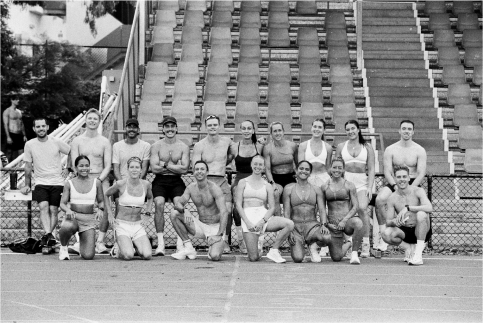
Expect to feel worse before you feel better, and read nothing into it. Ignore the scales. Ignore the itch. Start the race like someone who knows how far 42.2 km is.
1. Banister EW, Calvert TW, Savage MV, Bach T. A systems model of training for athletic performance. Australian Journal of Sports Medicine. 1975;7:57-61.
2. Bosquet L, Montpetit J, Arvisais D, Mujika I. Effects of tapering on performance: a meta analysis. Medicine & Science in Sports & Exercise. 2007;39(8):1358-1365.
3. Mujika I, Padilla S. Scientific bases for precompetition tapering strategies. Medicine & Science in Sports & Exercise. 2003;35(7):1182-1187.
4. Smyth B, Lawlor A. Longer disciplined tapers improve marathon performance for recreational runners. Frontiers in Sports and Active Living. 2021;3:735220.
5. Luden N, Hayes E, Galpin A, et al. Myocellular basis for tapering in competitive distance runners. Journal of Applied Physiology. 2010;108(6):1501-1509.
6. Trappe S, Harber M, Creer A, et al. Single muscle fiber adaptations with marathon training. Journal of Applied Physiology. 2006;101(3):721-727.
7. Olsson KE, Saltin B. Variation in total body water with muscle glycogen changes in man. Acta Physiologica Scandinavica. 1970;80(1):11-18.
8. Burke LM, Hawley JA, Wong SHS, Jeukendrup AE. Carbohydrates for training and competition. Journal of Sports Sciences. 2011;29(S1):S17-S27.
9. Warden SJ, Davis IS, Fredericson M. Management and prevention of bone stress injuries in long-distance runners. Journal of Orthopaedic & Sports Physical Therapy. 2014;44(10):749- 765.
10. Stone MJ, Knight CJ, Hall R, Shearer C, Nicholas R, Shearer DA. The psychology of athletic tapering in sport: a scoping review. Sports Medicine. 2023;53(4):777-801.
11. Jones G, Hanton S, Swain A. Intensity and interpretation of anxiety symptoms in elite and non elite sports performers. Personality and Individual Differences. 1994;17(5):657-663.
12. Hanton S, Jones G. The acquisition and development of cognitive skills and strategies: I. Making the butterflies fly in formation. The Sport Psychologist. 1999;13(1):1-21.
13. Smyth B. Fast starters and slow finishers: a large-scale data analysis of pacing at the beginning and end of the marathon for recreational runners. Journal of Sports Analytics. 2018;4:229-242.
Epictetus quotation: Enchiridion, chapter 5, Thomas Wentworth Higginson translation, 1890. Public domain.

Every event, every review, every club you love. Start your free RunDais account and keep it all in one spot.